
He global UAV market has fractured into a dozen distinct mission segments — each placing a fundamentally different set of demands on the propulsion stack. A Group 3 tactical reconnaissance drone operating at 25,000 ft has almost nothing in common with a high-speed target drone designed for sub-sonic interception training at sea level. The propulsion community has warmed to turbojets across a wider range of platforms than most people outside the sector realize, yet the evaluation logic tends to live in engineers' heads rather than any document a new program can actually reference.
What follows is a framework for working through those harder questions — where the real performance trade-offs sit, what the procurement process tends to miss, and why a low per-unit cost at contract signature can quietly become the program's most expensive decision once field logistics and integration rework are on the table.
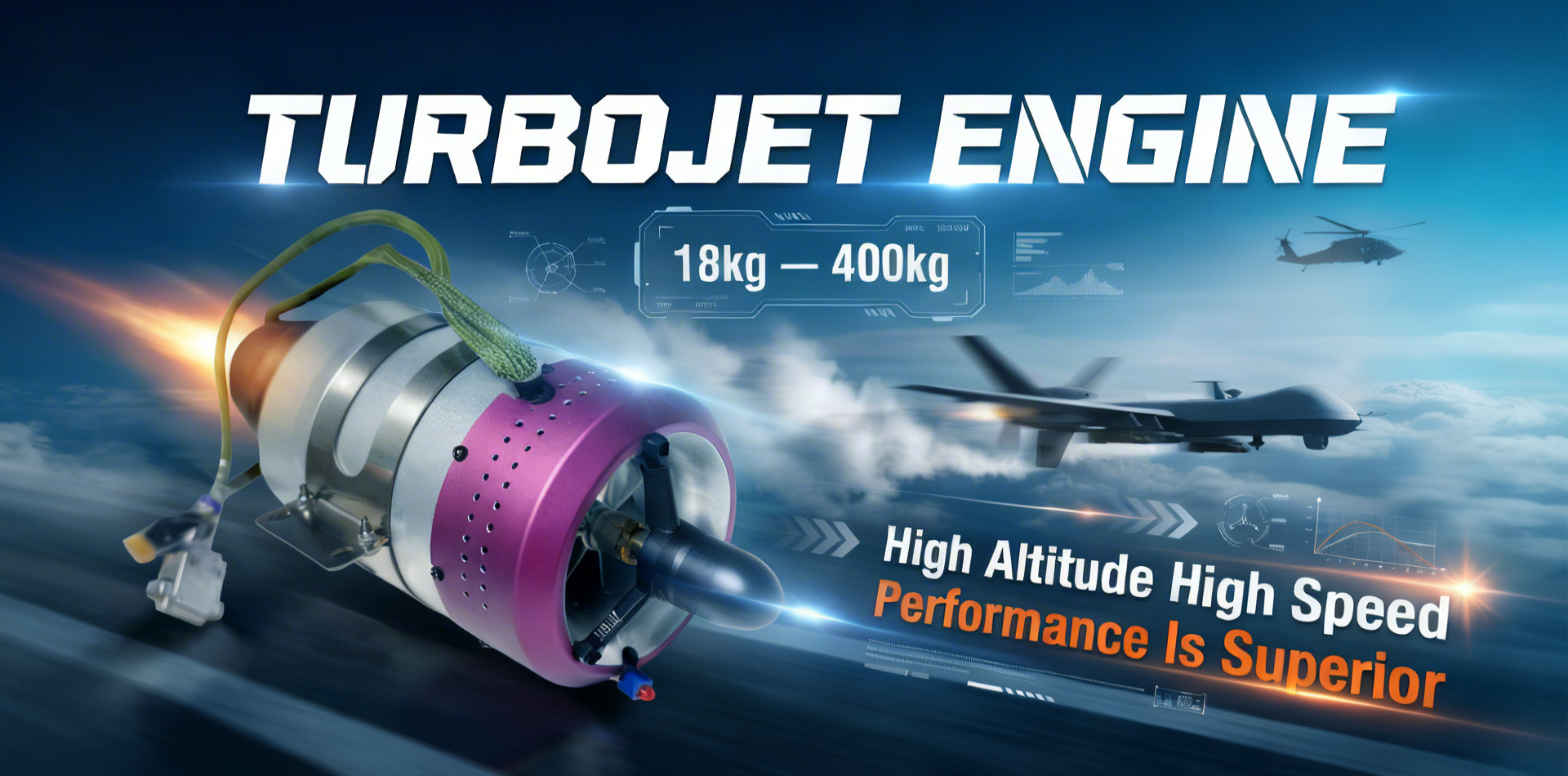
Why Turbojets — and not Turbofans — for UAV Applications
Ask any propulsion engineer why they didn't go with a turbofan and the answer usually comes back to diameter. Turbofans earn their efficiency advantage through bypass ratio, but that ratio requires physical space — space that simply doesn't exist in most small and medium UAV fuselages. Once you're above Mach 0.65 on a platform with tight cross-section constraints, the conversation tends to close itself.
A turbojet's simpler architecture translates directly into a smaller frontal cross-section. For a loitering munition or high-speed ISR platform with a fuselage diameter under 300 mm, packaging a bypass fan is simply not feasible without a complete redesign of the aerodynamic envelope. More importantly, at speeds approaching Mach 0.8 and above, the ram pressure recovery at the intake begins to compensate for the turbojet's inherently higher specific fuel consumption, narrowing the efficiency gap that would otherwise favor a turbofan.
There is also the question of parts count. Every additional turbine stage, every bypass duct, and every fan blade is a potential failure mode. For expendable or semi-expendable platforms, the added complexity of a turbofan is unjustified. MTBF targets for a loitering munition engine might be as low as 30 flight hours — a figure that makes the superior durability of a high-bypass turbofan completely irrelevant.
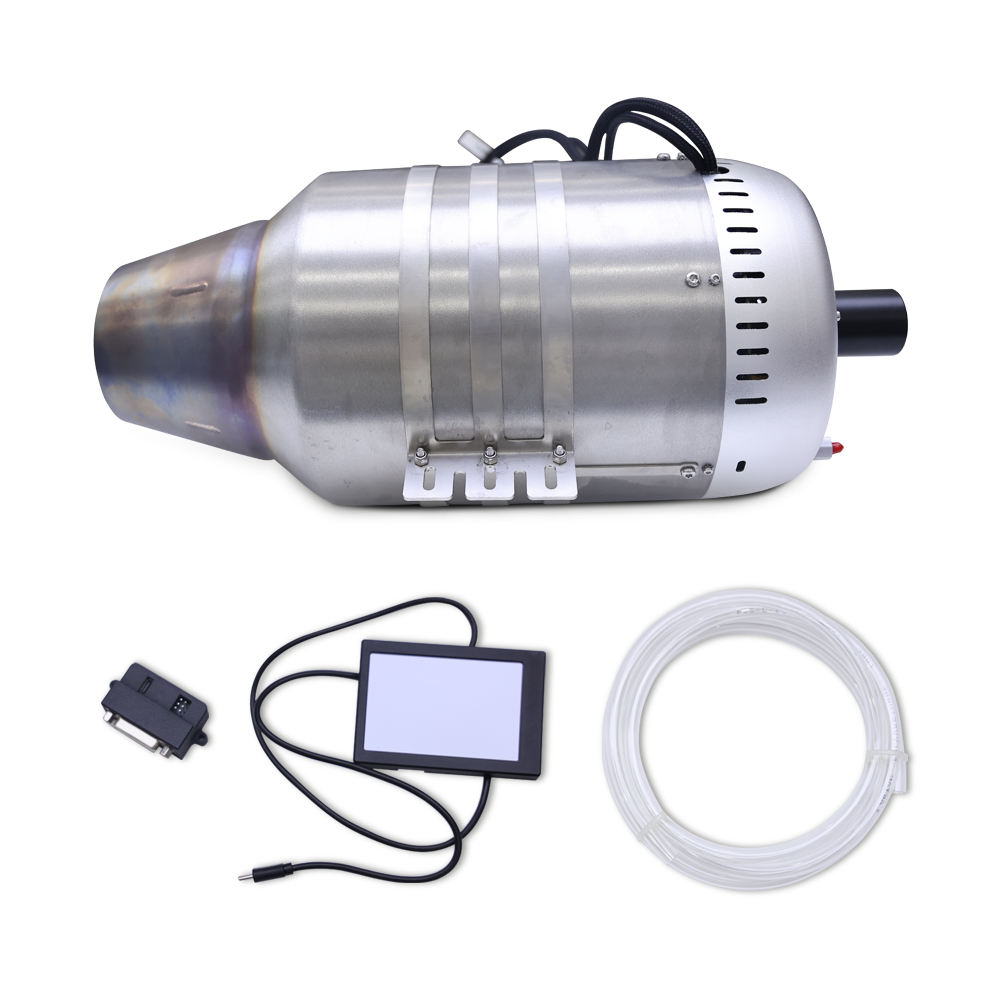
The Three Variables That Actually Drive the Selection Decision
1. THRUST CLASS AND ALTITUDE-CORRECTED PERFORMANCE
Walk through any engine manufacturer's product page and you'll find SLST front and center — sea-level static thrust, clean conditions, standard atmosphere. It's the most flattering number they can publish, and for UAV applications, it's largely beside the point.What matters is thrust available at the design cruise altitude and speed — values that require the full thermodynamic cycle model, not a single datasheet figure.
For a fixed-wing UAV cruising at 8,000 m ISA and Mach 0.72, the effective net thrust can be 40–55% lower than the published SLST figure depending on inlet design, bleed extraction for avionics cooling, and turbine entry temperature limits at altitude. Engineers who spec an engine purely on sea-level numbers and apply a rough altitude correction often find themselves 15% short of the required thrust margin on the first flight test.
The correct approach is to request the thrust lapse rate curve from the manufacturer — thrust vs. altitude at constant throttle setting and Mach number — and overlay this against your mission drag polar. An OEM that can't produce this data hasn't done the thermodynamic groundwork — or doesn't want you to see it.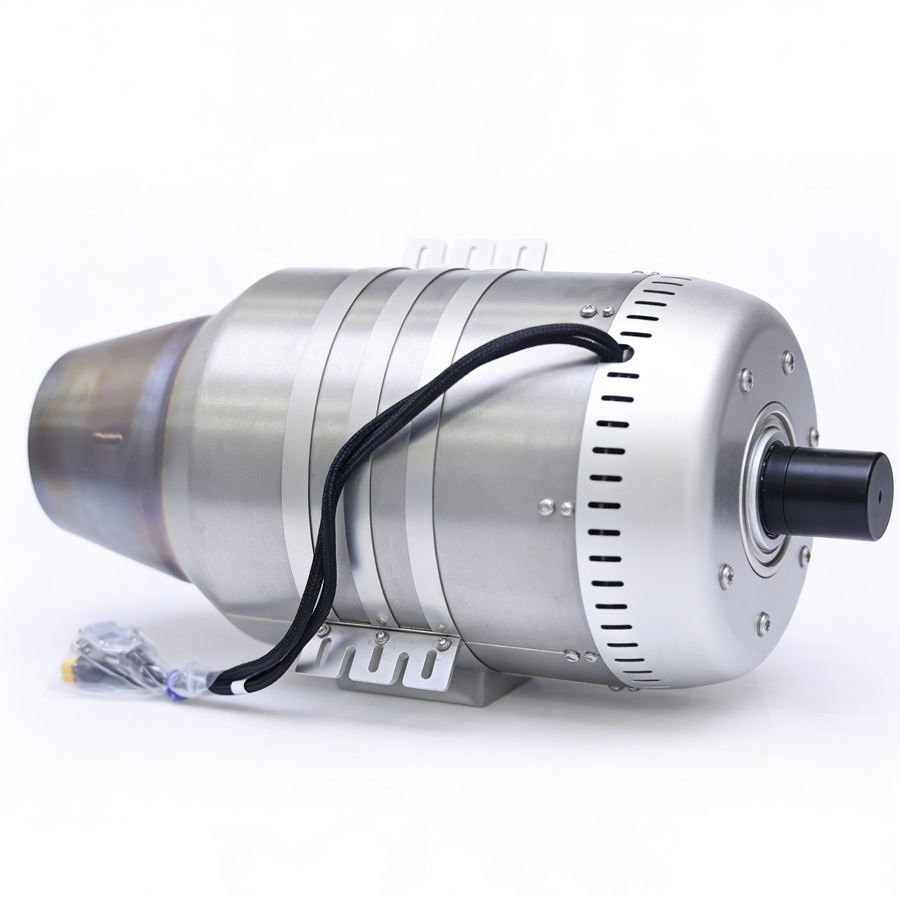
2.SPECIFIC FUEL CONSUMPTION ACROSS THE THROTTLE RANGE
SFC at maximum continuous thrust is widely quoted. SFC at partial power — where most long-endurance UAVs spend the majority of their flight time — is rarely disclosed without a direct engineering inquiry. The two numbers can differ dramatically depending on the compressor map design.
Centrifugal compressors, which dominate the sub-500 N class of small turbojet engines, have a narrower efficient operating band than axial-flow designs. At 65% of maximum power — a typical cruise setting for a persistent surveillance drone — a centrifugal compressor stage can be operating significantly off its design point. This shows up as a disproportionate degradation in SFC relative to thrust reduction, shortening the endurance envelope in ways that are not obvious from the published data alone.
Axial-flow designs, used in larger and more expensive engines starting around 1,000–2,000 N, offer a flatter SFC curve at partial power. Axial compressor maps cover enough of the operating range that partial-power SFC doesn't collapse the way it does when a centrifugal stage drifts off its design point. None of that comes free — axial stages are dimensionally unforgiving to manufacture and considerably more involved to balance.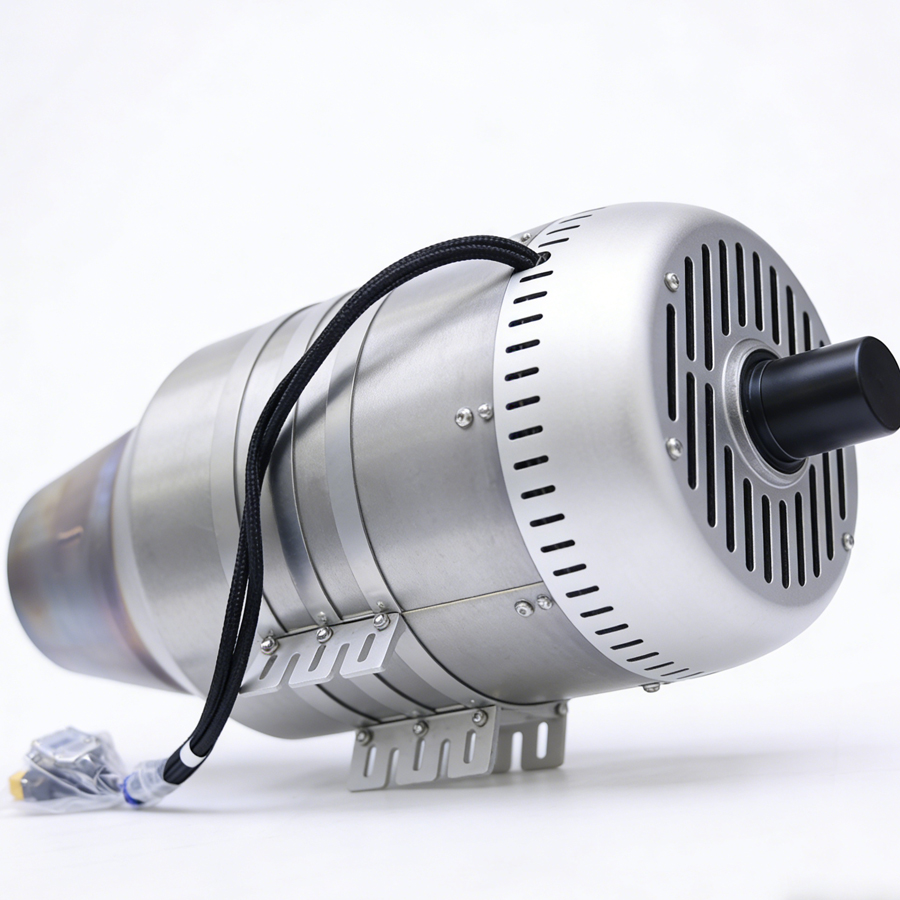
3. STARTING SYSTEM ARCHITECTURE
Starting system selection gets less attention than it deserves in early design reviews, and that tends to show up as an operational problem later. Three architectures cover most of the UAV turbojet market: electric starter/generator combinations, solid-fuel pyrotechnic cartridges, and air-turbine starters drawing from a ground cart or onboard pneumatic source.
Electric starters dominate smaller tactical and commercial platforms. The practical advantage is restart capability — multiple attempts per sortie without ground crew involvement. The hard constraint is peak current draw at light-off: a 500 N class engine typically pulls 200–400 A for several seconds, which the battery system and wiring harness both have to be sized around from the start.
Pyrotechnic starters trade that flexibility for compactness. One cartridge, one start — if the mission aborts and the aircraft recovers, the engine doesn't restart on the field. For loitering munitions, that's an acceptable constraint. The reliability under temperature extremes is generally solid, but cartridge shelf-life tracking and hazmat handling add a logistics layer that programs consistently underestimate until they're managing it in the field.
Due Diligence: What to Request from the Manufacturer
Before committing to an engine supplier, a responsible procurement team should formally request — not merely ask for — the following documentation and data sets. The completeness and quality of the response is itself diagnostic of the manufacturer's engineering maturity.
First, the full engine performance deck: thrust, fuel flow, EGT, and compressor outlet pressure as a function of altitude, Mach number, and throttle setting (expressed as % N1 or corrected fuel flow). This should cover the ISA envelope from sea level to the maximum design altitude, with hot and cold day corrections. Second, the turbine temperature budget, including the TIT operating limit at maximum continuous and take-off power ratings, with confirmation of how the FCU enforces these limits under transient throttle inputs.
Qualification documentation is the third area to press on. If formal test reports aren't available, ask which standard the engine was developed against — MIL-E-5007, DEF STAN 00-971, or a proprietary spec — and get that answer in writing rather than in conversation. The bill of materials matters here too — sub-assembly level, covering the hot section and fuel system, with country-of-origin declarations for anything that could fall under export control review. Alongside that, the maintenance and overhaul plan in full: inspection intervals, life-limited parts, and the service bulletin history on units already in the field. That last item is particularly telling — a clean SB record on a mature engine is one thing; a sparse record on a platform with limited flight hours is another.
A supplier that takes weeks to pull this together, or answers qualification questions in general terms rather than with specific documents, is telling you something about how the program was run. Performance figures don't change that reading.
Looking Ahead: Where the Technology Is Moving
Several development trends are reshaping the turbojet options available to UAV platform designers over the next five years. Additive manufacturing of hot section components — turbine blades, combustion liners, and compressor impellers — is moving from prototype demonstration into low-rate production at a handful of suppliers. The implications for UAV engines are significant: geometrically complex internal cooling channels that were previously manufacturable only in large high-bypass turbofans become feasible at the 500 N scale, potentially enabling higher TITs with acceptable blade life.
Advanced fuel flexibility is another area under active development. Most current UAV turbojets are optimized for Jet-A or JP-8. Military sustainability requirements have pushed kerosene-equivalent synthetics and HEFA fuels into formal qualification testing against fielded engine types — a process that was largely theoretical five years ago. Designers specifying engines for programs with a ten-year horizon should be asking manufacturers about their roadmap for alternative fuel qualification.
Hybrid-electric integration is the third shift worth tracking, particularly in the 100–500 N thrust class. The basic operating logic is straightforward: the turbojet holds a narrow, fuel-efficient power band while electric motors absorb the throttle transients that would otherwise push the engine off its design point. What that does to the SFC curve over a four-to-six-hour endurance mission is meaningful — the fuel savings aren't marginal. The system-level complexity is a genuine engineering burden, and the weight penalty of the battery and power electronics has to be accounted for honestly in the mission analysis. For programs where endurance is the primary constraint, that accounting tends to come out favorably. For others, it won't.