
Drone incidents around airports, correctional facilities, and public events have moved from rare headlines to a recurring operational problem. As unauthorized UAV activity climbs, the RF module at the core of a jammer has become the part buyers scrutinize most closely — not the enclosure, not the antenna, but the board that generates the disruption signal. This article covers the questions integrators typically ask when evaluating a 50W UAV Drone Jamming Module, using a current production unit as the reference.
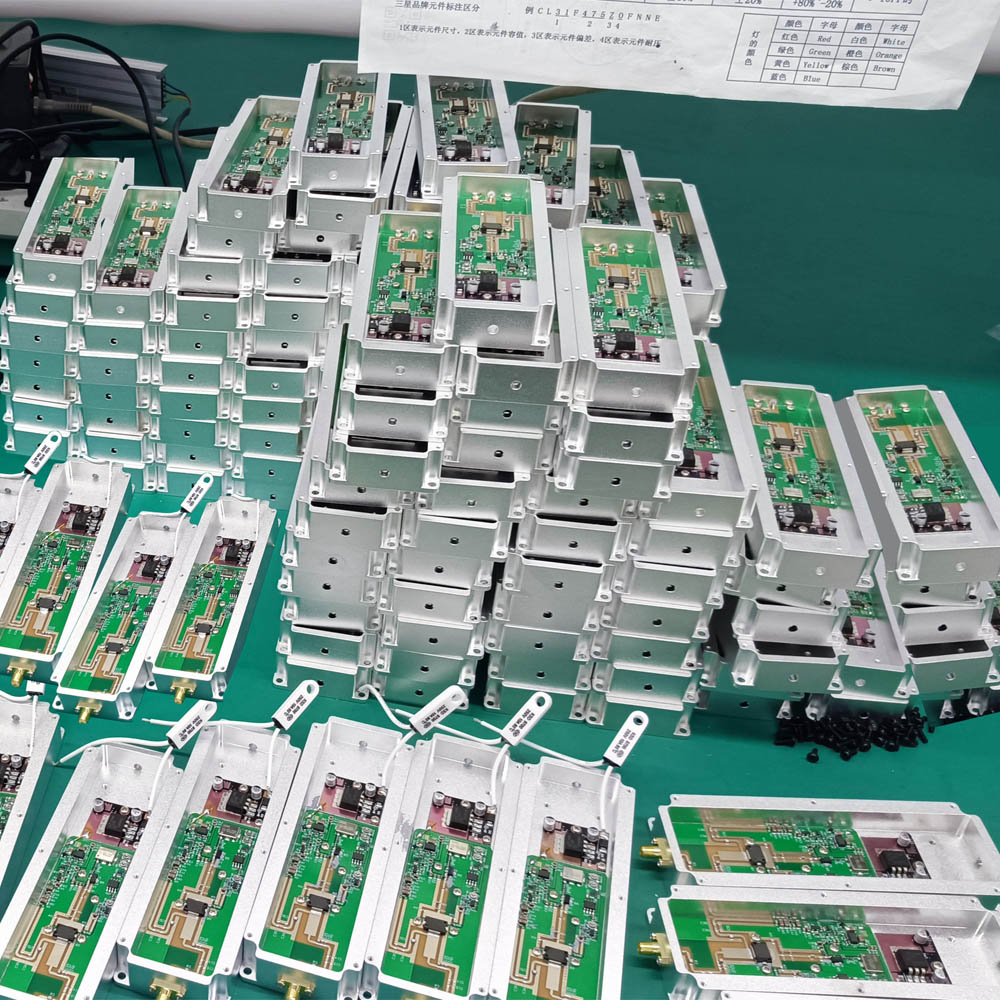
Frequency Coverage: The First Thing Buyers Check
Almost every inquiry starts the same way: which band does the module actually cover, and can it be adjusted once it arrives? Commercial drones rely on a narrow set of control and telemetry bands, so a jammer built for the wrong one is effectively useless against that drone family. This 50W platform is offered across ten selectable frequency segments spanning the full range consumer and semi-professional drones use — the low VHF/UHF control bands around 400–500 MHz and 500–600 MHz, the mid bands at 700–840 MHz and 840–960 MHz, the 950–1500 MHz telemetry range, and the 2.4 GHz and 5.15–5.9 GHz Wi-Fi-based video and control links most quadcopters depend on. Each module ships built for one specific band, chosen at order time, with a bandwidth tolerance of roughly ±10 MHz around that center frequency.
Within its assigned band, a module isn't fixed in stone: center frequency and bandwidth can both be fine-tuned mechanically using onboard adjustment screws, so an integrator can correct for drift or shift coverage slightly after a firmware or antenna change without sending the unit back to the factory. For a multi-band UAV Drone Jamming Module or a gun-style housing that needs to defeat several drone links at once, the standard approach is to stack several single-band modules side by side — one module per target band — rather than expect one board to sweep the entire spectrum on its own.
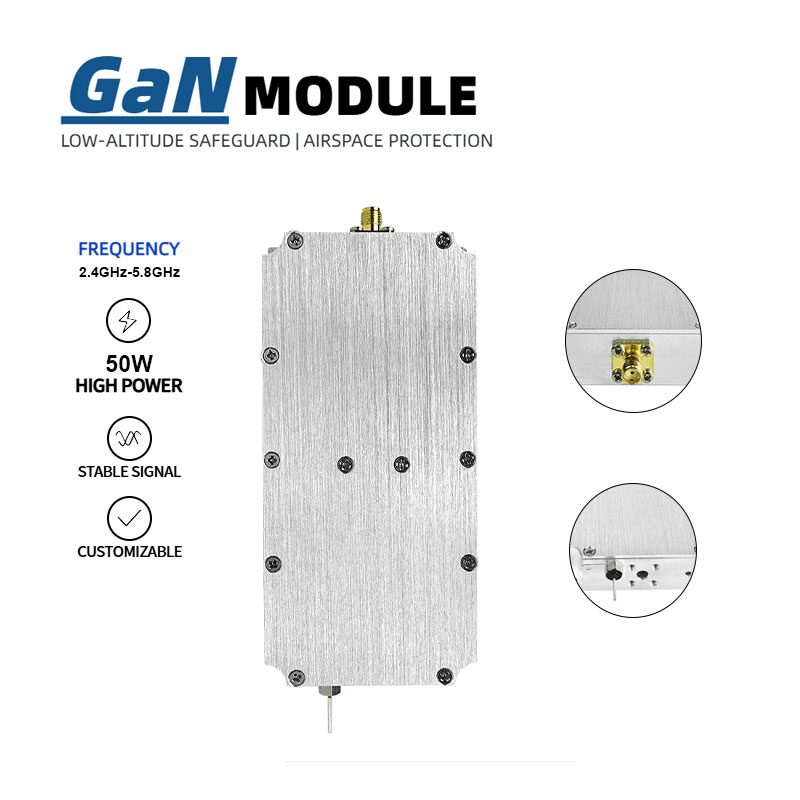
Output Power, Gain, and Why Stability Beats Peak Numbers
A 50W rating gets attention, but experienced buyers ask a follow-up question almost immediately: how stable is that output across temperature and time? This particular Anti drone module delivers a maximum output of 47±1 dBm with matching gain, running on a 24–30V supply and drawing up to roughly 4.2A at full 50W output. More telling is the in-band ripple, held to within 3 dB peak, and gain/power stability of ±1 dB across a −20°C to +65°C working range. For vehicle-mounted or outdoor fixed installations, that thermal window is often the deciding factor over raw wattage, since a jammer that drifts in output as it heats up becomes unpredictable exactly when it needs to perform.
Output VSWR protection is another recurring line item in technical questionnaires. This module uses a built-in circulator to keep VSWR at or below 1.5, protecting the amplifier stage from reflected power if the antenna is mismatched or briefly disconnected — a practical safeguard for field units swapped between antennas or mounted in imperfect RF environments.

Customization: The Question Behind the Question
Almost nobody orders this board exactly as it sits on the datasheet. What usually happens is a buyer gets partway through specifying their system and realizes the stock configuration won't quite match their waveform strategy or their power budget, and the conversation shifts to what can actually be changed. The signal source is one of the first things that comes up. Out of the box, the module runs on a built-in high-speed noise modulation generator, but that source can be replaced with a customer's own VCO, DDS, or SDR if their jamming approach calls for something more specific than broadband noise.
Sweep speed defaults to 120 kHz at an 8 μs step, adequate for static control links on most consumer drones. Hopping links are different — if the radio changes channel faster than the module sweeps, the two may never align. For that case, sweep rate can be set from 50 to 300 kHz at order time, with buyers typically specifying the higher end for agile or frequency-hopping targets.
The enable-control line(24–28V) lets an external controller switch individual modules on or off. In multi-band housings this keeps current draw in check — only the band matching the detected threat is powered, the rest stay idle.
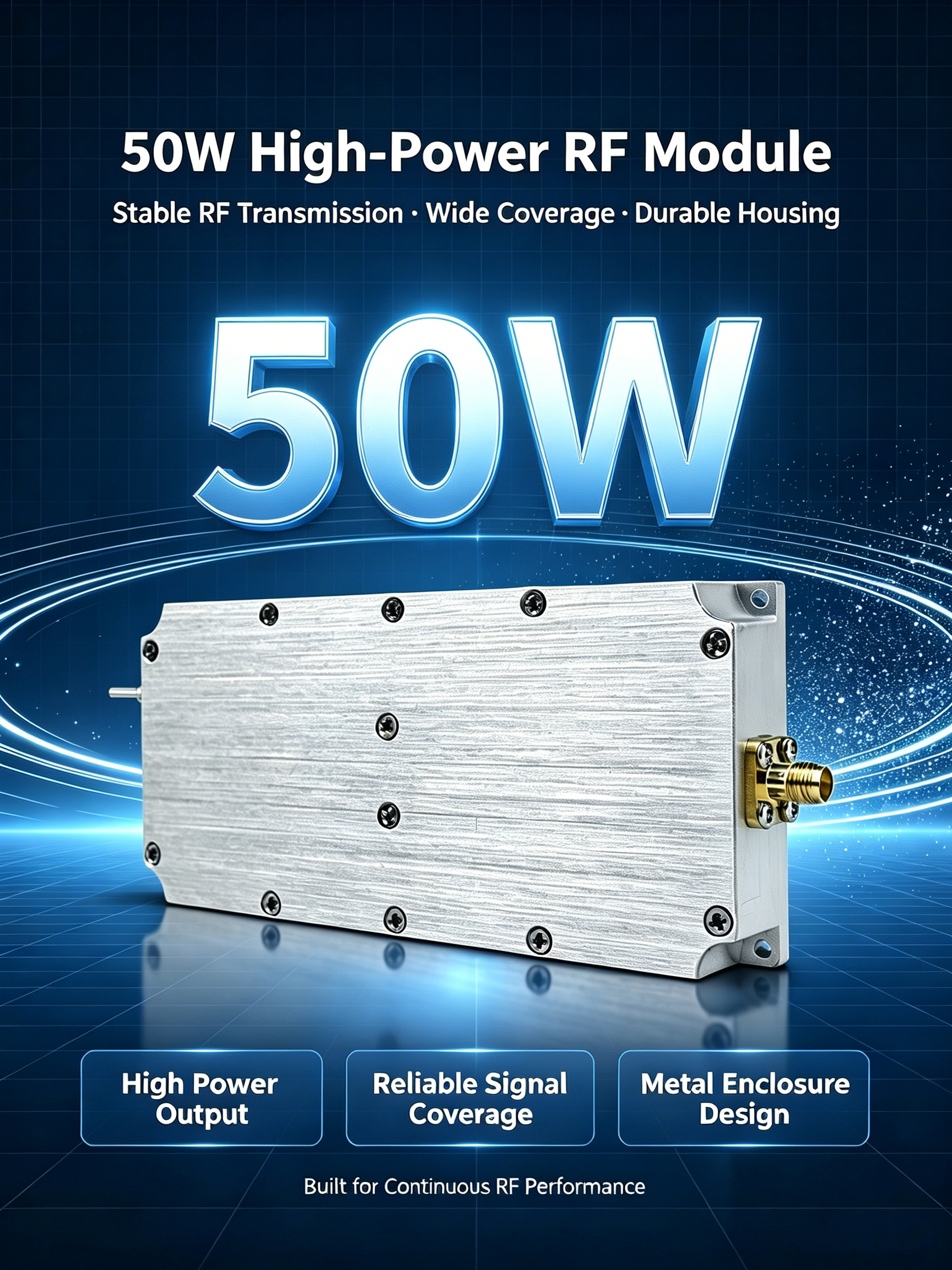
Mechanical and Integration Details That Get Overlooked Early
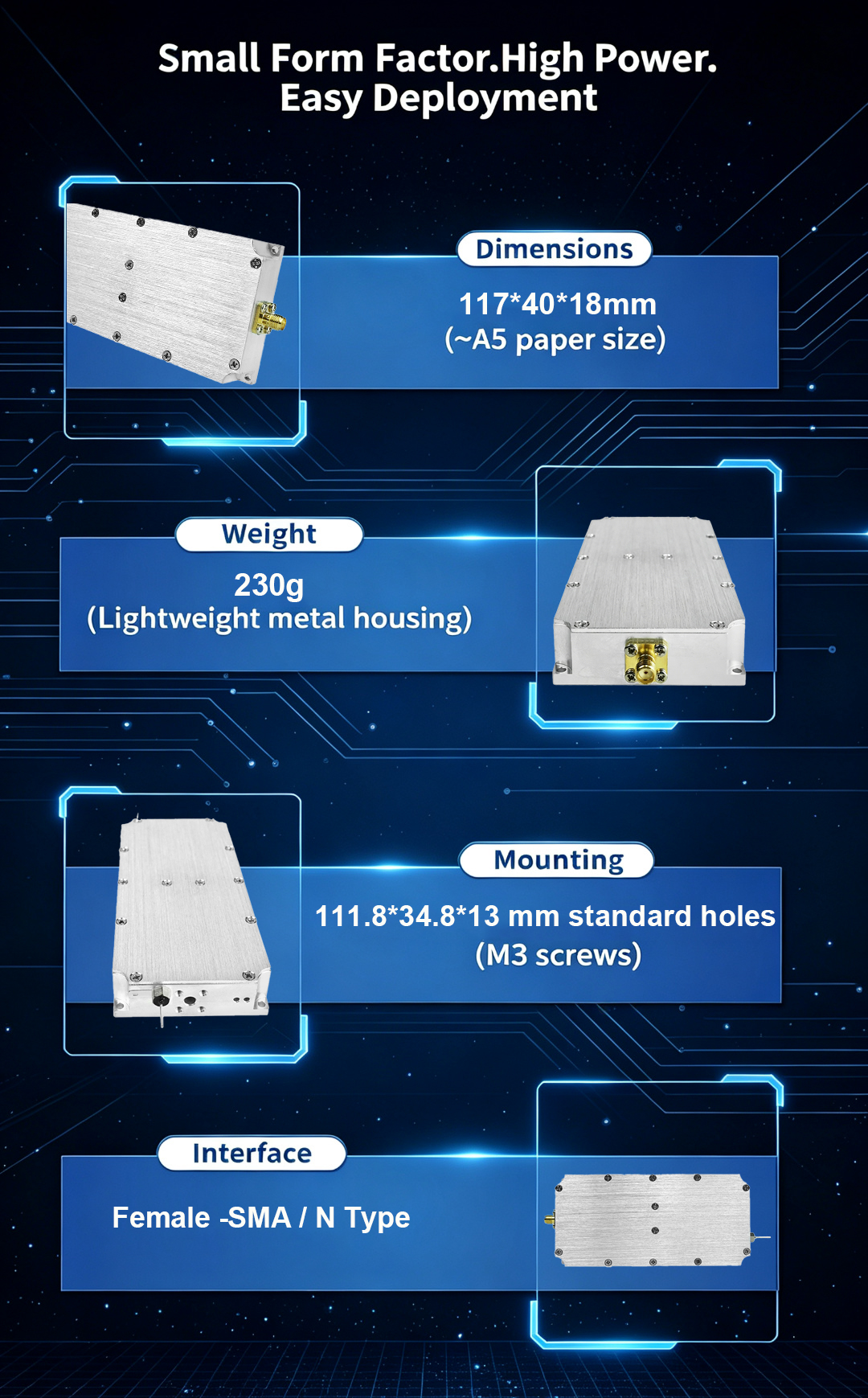
Physical footprint comes to 117 × 40 × 18mm, with the mounting base at 111.8 × 34.8 × 13mm and M3.2 screw holes. That's tight enough to line up five or six boards inside a single gun-style housing without changing the shell.230 grams per board, times six in a full build, lands around 1.3kg for the modules alone — check that against what the housing can carry before locking in parts.
Aluminum construction, sandblasted with a natural oxide layer on the outside. It pulls heat off the board and takes vibration well once mounted in a vehicle. Antenna connection is SMA-female, and there's an LED on the board that lights up when power is present — no meter required to confirm the unit is on.
Where This Fits in the Broader Market Conversation
Single-purpose jammers are giving way to layered setups — detection sensors paired with modular mitigation hardware — and RF jamming still handles most of the actual neutralization work in these deployments. That shifts the burden onto individual RF modules: they need to swap in and out easily, tune in the field, and hold up thermally, not just post a big number on a spec sheet. Airports, prisons, border posts, and event security are where demand is growing fastest right now, and the questions from these buyers tend to repeat — full-band coverage, output that doesn't drift with heat, VSWR protection, and sweep rates that can be matched to whatever threat they're actually facing.
For engineers sourcing a UAV Drone Jamming Module for a new build, or comparing it against an existing UAV Drone signal blocker design, the spec sheet only tells part of the story. Thermal drift, VSWR protection, sweep customization, and mechanical fit are usually worth asking about directly before placing an order.