
We had a customer last year whose forklifts kept losing position the moment they rolled into the loading bay — nothing wrong with the receivers, just concrete and rebar between them and the sky. GPS antennas are designed around a clear view of sky — that's the baseline assumption behind the whole system. Put one layer of rebar-reinforced concrete between the antenna and the receiver, and the signal can drop 20 dB or more before it reaches a unit two floors down. Warehouses running RTLS feel this constantly. So do underground fleet yards, and data centers that lean on GPS for time-stamping — the receiver doesn't fail loudly, it just quietly starts logging bad positions or drifting out of sync.
The fix the industry has settled on isn't a stronger receiver. It's moving the antenna outside the building and piping a clean, amplified copy of the signal to wherever it's needed. That's the logic behind a GNSS Reradiation Antenna system: a donor antenna sits on the roof with a clear view of sky, a distribution amplifier boosts and splits the signal, and a set of indoor rerad antennas rebroadcast it through the structure. The chain is only as good as its weakest link, and that link is usually the outdoor pickup antenna — exposed to weather, vibration, lightning, and years of thermal cycling while everything downstream depends on what it captures.
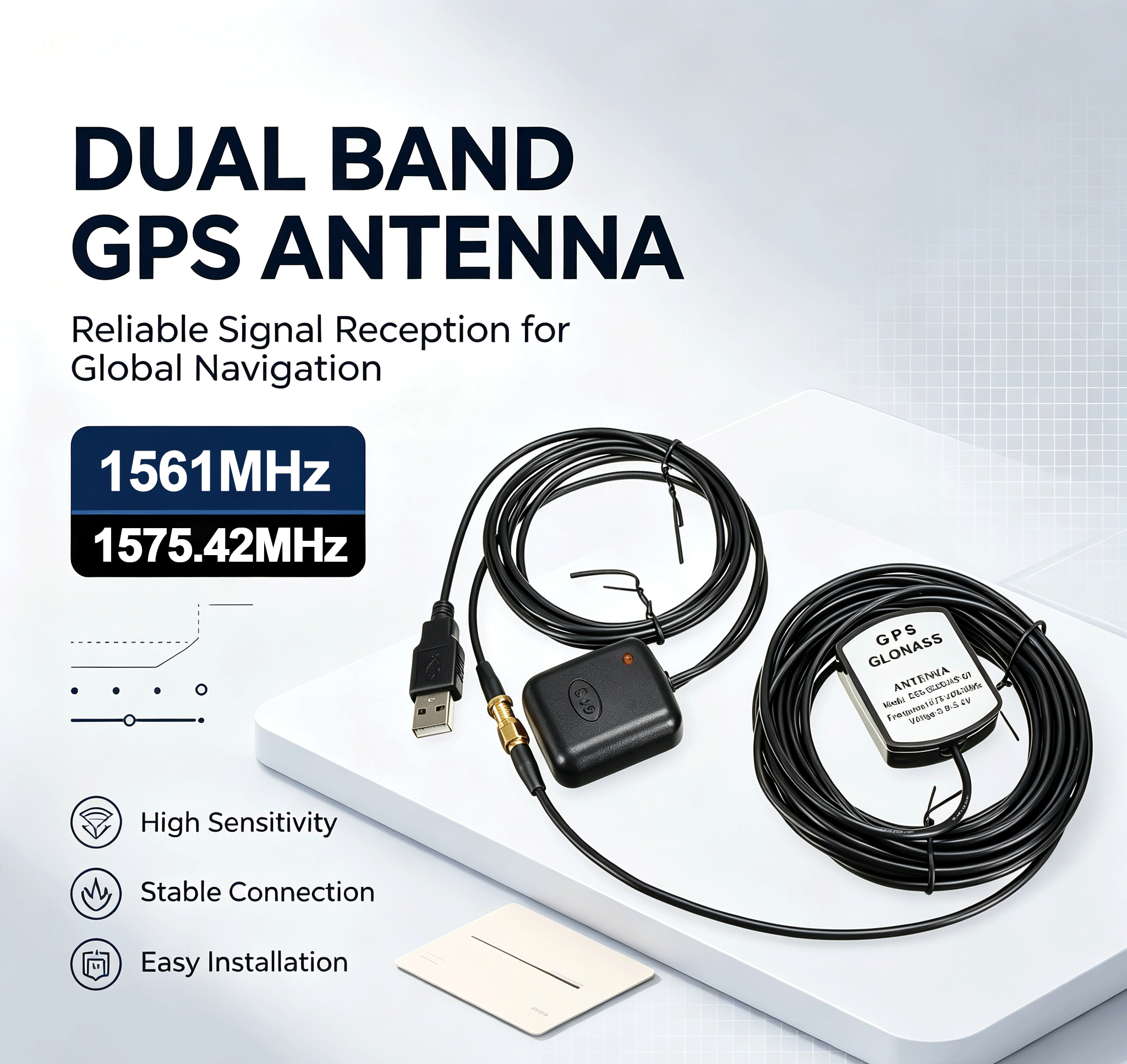
The Spec Sheet Details Buyers Skip
Gain and VSWR get all the attention in RFQs. The mechanical and environmental numbers get glossed over, and they're usually the reason an antenna fails in year two rather than in bench testing. This unit's qualification run is a decent template for what to ask for:
· Bend/flex: a 120g load hung 30cm from the connector, swung 60° each direction, 1,000 cycles, no measurable RF degradation afterward — relevant wherever the pigtail runs through a conduit bend or gets flexed during maintenance access.
· Pull force: 7kg sustained tension on the cable-to-connector joint without damage, the number that predicts whether an installer's cable-management habits will eventually snap a connection.
· Vibration: 1.10mm amplitude at 33.30 Hz/sec across X, Y and Z axes, Z-axis run at 240 minutes versus 120 for X and Y — sensible, since rooftop mounts see more vertical excitation from HVAC equipment and wind buffeting than lateral movement.
· Salt spray: 48 hours at pH 6.5–7, 1kgf/cm² air pressure, 98% relative humidity, all post-test parameters within 30% of baseline — the figure separating an antenna meant for a coastal rooftop or marine deck from one only rated for a dry inland install.
· Thermal range: -30°C to +85°C operating and storage, with 48-hour soaks at each extreme followed by post-conditioning checks.
· Wind resistance: rated to 60 m/s, covering sustained high-wind exposure without a separate radome reinforcement.
· Lightning protection: DC grounding built into the antenna body rather than relying entirely on downstream surge suppression — relevant wherever the antenna is the highest point on a roof.
None of these show up in a typical one-line spec comparison, but they're what determines whether a reradiation system needs a truck roll in eighteen months or runs quietly for a decade.
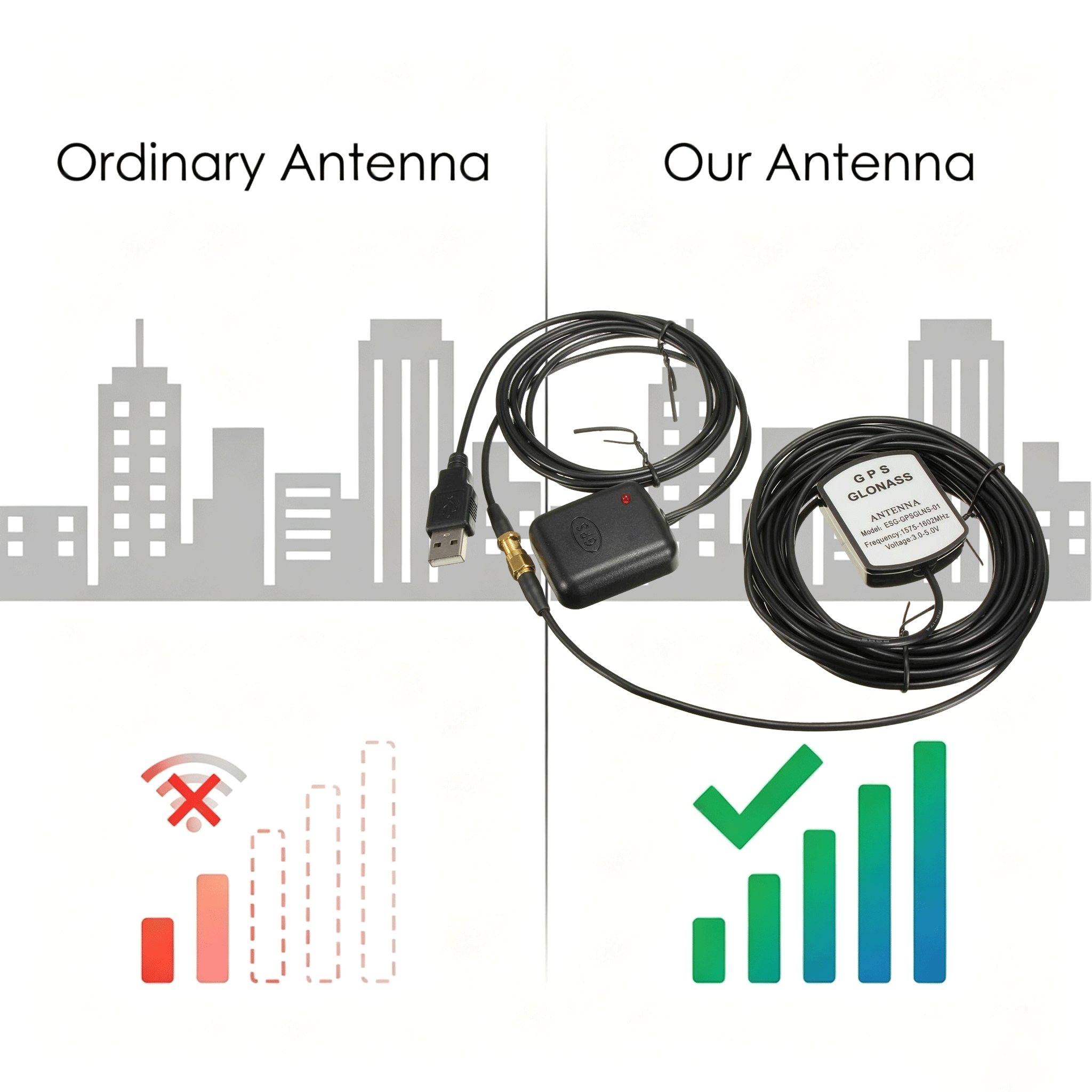
RG174 and SMA-J: The Cable Choice Nobody Asks About Until It's a Problem
Installers care about RG174 and SMA-J for reasons that never show up on a spec comparison chart. RG174 bends. It threads through a tight conduit run or a ceiling void without fighting the installer the way thicker coax does — and on a retrofit, the cable path was decided by the building years before anyone picked an antenna vendor. You take what the conduit gives you.
The catch is loss per meter. RG174 bleeds more signal over distance than RG58 or an LMR-series cable, so past roughly 10-15 meters, the smart move is running lower-loss cable for the bulk of that distance and switching to RG174 only for the last stretch into the connector — or adding an inline amplifier if the run can't be shortened.
The Gain Number Isn't the One That Matters
A buyer we talked with last quarter had already picked an antenna based on gain alone before realizing the vendor couldn't produce salt-spray data past 24 hours. The GNSS GPS antenna went back to RFQ.
Gain is easy to put in a spreadsheet, so it gets treated as the deciding factor. It rarely is. VSWR measured only at center frequency tells you almost nothing about how the antenna behaves across the rest of the band — ask for the full curve. Salt-spray and thermal data matters more if it was actually run against a named standard like GB1266-86, rather than some in-house test nobody outside the factory has seen. And pull force on the connector needs to match reality: how the cable actually gets routed, clamped, and pulled on once it's sitting on a roof in the wind.
Nobody installs a second antenna as backup for a rooftop reradiation setup — the cost doesn't work, and honestly most people don't think they need to. But that also means when the one antenna you have starts drifting off spec, there's no fallback catching it. A connector that works loose or a VSWR that creeps up over a year won't trip an alarm. It just shows up eventually as weaker signal on the third floor, then the fifth, and somebody ends up troubleshooting a "software issue" that was actually hardware the whole time.